This isn’t about my own project, but I’d like to brag about it all the same.
The other night at dinner, our 5 year old daughter was telling us about a film she’d invented. This isn’t odd for her. Some children have imaginary friends to go on adventures with. Ours has an imaginary franchise: a universe of books, films, and a television show called Pitek(c)at (the ‘c’ is a bit uncertain in the spelling as you’ll find out). She’ll tell me about it in tidbits while I bring her to school or during playtime, going slightly back and forth on the details, but being consistent about the main points. It’s 3 films, a show which follows them chronologically, and I believe the books are mostly prequels. In the first, one of the characters becomes queen because her mother is killed by a bad guy (quite gruesomely, apparently. She described it in explicit detail once. Children’s minds are amazing). Then in the sequel they become monster hunters to stop those monsters from helping these same bad guys. And so forth. We’ve built up a canon over time, and I do my best to keep track.
So imagine my shock to find out that Pitekat’s entire run isn’t produced in either of the languages we speak! (we’re a bilingual household), but rather exists exclusively in a language called Kcalish. She dropped this on us in a hilariously “Oh no, you’ve got this all wrong” tone. Rather a major detail to leave out, I should think. No dubs are available either. Possibly there are subtitles, though as an early reader herself, she sees little point in them. True fans learn Kcalish.
After some questioning, and handing her pen and paper, I found out that Kcalish (pronounced /ˈkɐlɪʃ/) has its own orthography which takes about half its letters from the latin alphabet and has entirely new letters for the other half plus some. The Kcalish word for ‘pizza’ is ‘pitsu’, and ‘pasta’ is ‘patsu’. All her stuffies speak it fluently, by the way. It’s only us parents who come up short.
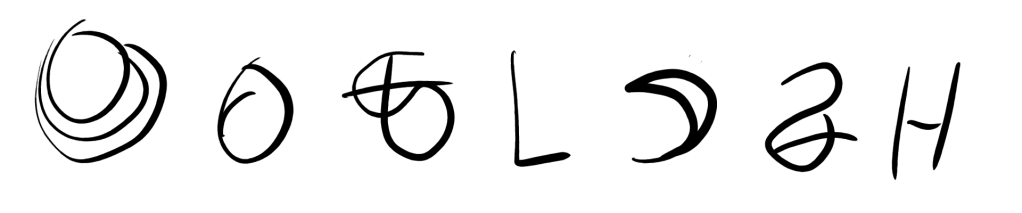
Filling in some blanks – probably more thought than she’s putting into it, I know – I suspect Kcalish is a posteriori conlang based in a germanic or romance language; probably the latter, based on her example words (which I can’t all reproduce well enough to write them out here) which sound similar to Spanish.
What confuses me is the “kc” spelling. She specifically says it’s spelled that way, so I can’t assume that’s a mistake. I do have to wonder: is it “Pitekat” or “Pitekcat”? My spouse thinks she’s actually learned that English words can end in ‘ck’ to sound like /k/ and assumed the same can be done at the start of words, which sounds plausible, but I’m going to take her choice at face value for the fun of it and theorise that either…
- “ka” wouldn’t be pronounced /kɐ/, but rather some variation like /qɐ/ or /xɐ/, making the extra ‘c’ necessary to establish correct pronunciation. In that case, is “pca” also valid, pronounced /pɐ/? I guess I’ll have to ask her.
- I misheard her rendering of the language’s name, and it’s actually /kʼɐlɪʃ/ or /cɐlɪʃ/ or /kxɐlɪʃ/ or something. “ka” would then be the expected /kɐ/.
It’s also conceivable that ‘kc’ is a holdover from an older spelling and the pronunciation has since collapsed. Goodness knows English makes colourful spelling choices for historical reasons.
Or she’s 5 and I’m overthinking this. I’m a nerd and a proud parent. I make no apology. Point is, I had better get to learning this language, because the plot sounds epic and I don’t want to miss out.


Leave a Reply